

What Is Liquidity, and How Does It Affect Your Orders?
Picture this: you try to buy a cryptoasset priced at $1.00 per token. The order fills at $1.03. Nothing went wrong, and no one tricked you. You just felt the effect of low liquidity in crypto.
It's one of the most used words in trading and one of the least explained. And yet, understanding liquidity in crypto trading can save you from unexpected costs and give you more control over your orders. So, here's what it means, and how it shapes every trade you make.
What is liquidity in crypto
Liquidity is a measure of how easily an asset can be bought or sold without moving its price. The more buyers and sellers active in a market, the more liquid it is.
When you trade a popular cryptoasset like Bitcoin, there is usually a large pool of buyers and sellers ready to trade. That means your order is more likely to go through quickly and close to the price you saw.
With a smaller, lesser-known token, fewer people may be trading. As a result, your order could take longer to fill or execute at a less favorable price than expected.
Why it matters for your trades
You experience the effects of liquidity in several ways whenever you place an order.
Spread. Also known as the bid-ask spread in crypto, is the gap between the highest price a buyer will pay and the lowest a seller will accept. On liquid assets, this gap is usually small. On less liquid assets, it tends to widen, increasing the effective cost of entering or exiting a position.
Slippage. In crypto trading, slippage happens when there are not enough orders available at the price you expected. You might place an order at $1.00, but as it moves through the available orders in the market, part of it may fill at a higher price. In a liquid market, the difference may be barely noticeable. In a less liquid one, it can add up quickly.
Crypto order execution. Liquidity also affects how quickly, and completely, your order is filled. In a thin market, your order may fill only partially or remain open while it waits for someone to take the other side.
How to check liquidity before you trade
Two quick checks tell you most of what you need, and you can do both in seconds.
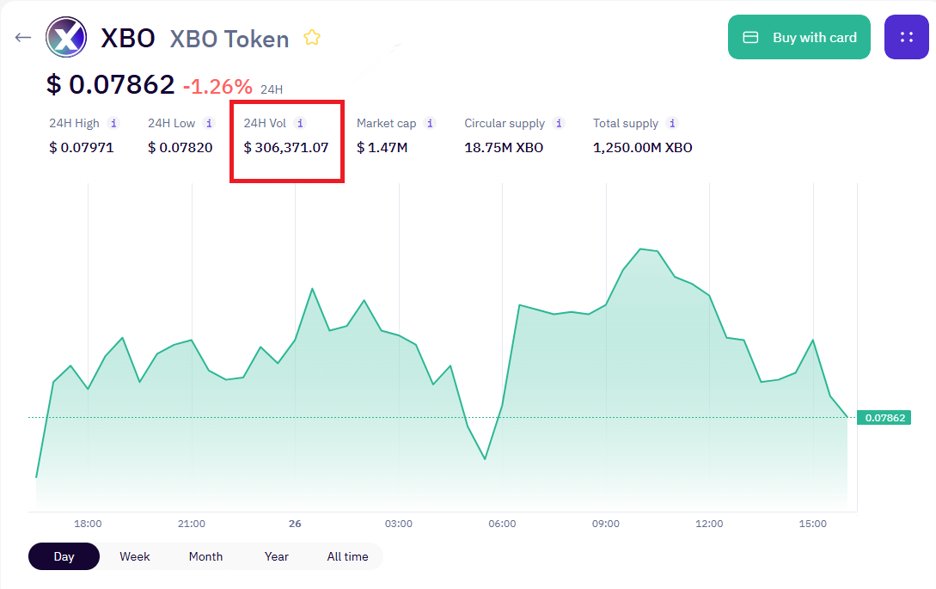
1) Check the 24-hour volume. Higher crypto trading volume usually means more buyers and sellers, and more liquidity. You'll find it as "24H Vol" near the top of any asset page.
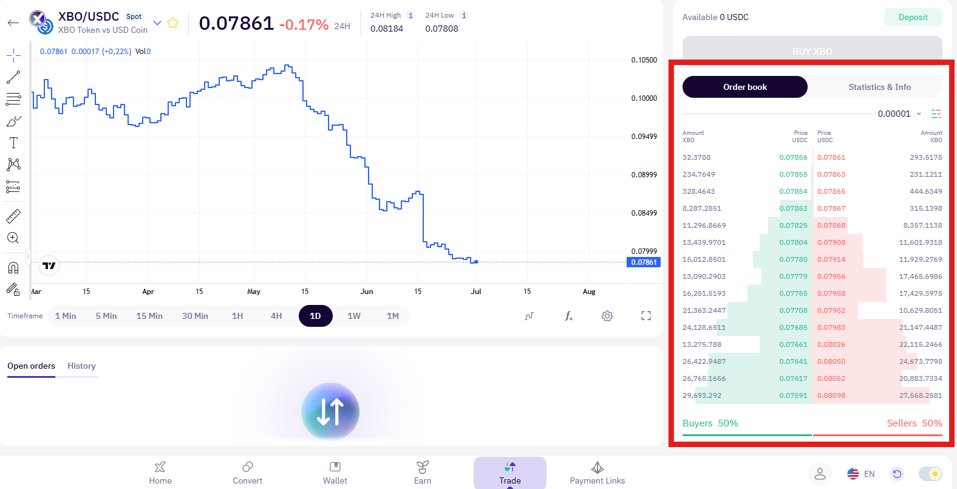
2) Look at the crypto order book. On the Trade screen, start with the spread: the gap between the highest buy price and the lowest sell price. When the two prices are close together, that is generally a positive sign. Then check the crypto market depth by examining the order sizes behind the spread. Large orders mean the market can absorb your trade and fill it close, or exactly, at the price you want. A tight spread with only small orders can still cost you. Once your trade uses up those orders, the remainder may fill at less favorable prices.
A 10-second habit worth building
Next time you open a trade on XBO.com, take ten seconds to check the volume, the spread, and the order sizes before you confirm. Strong volume, tight spread, and solid depth behind it mean you'll likely get a fair, fast fill. Thin volume, wide gap, or shallow orders are a sign to be cautious. It's one of the simplest crypto trading tips out there, but it can save you more than you expect.
Disclaimer: Our content does not constitute financial advice. It is only intended for informational and educational purposes.