

Weekly Crypto Update (June 18th 2026) - BTC Holds Support, Fed Keeps Rates Steady | XBO

Analyst Summary
The crypto market moved in two phases this week. In the first half, Bitcoin gained around 4% on expectations of a peace deal between the United States and Iran, but it then reversed after the Fed meeting, where the rate was left unchanged as expected and the new chair's tone came across as neutral-to-hawkish. Bitcoin's decline was restrained: the decision was no surprise, and order-flow and on-chain data show no aggressive selling - we are seeing deleveraging rather than loss realization. XBO's current view is neutral-to-bullish over the short and medium term, provided support around $62,000 holds and the order book retains its buy-side skew. The key signal to watch is whether price can return above the $66,500 zone, where large sell orders are concentrated.
Key Market Snapshot
|
Asset |
Weekly Change |
Trend |
Analyst Bias |
|
BTC |
+4.1% |
Ascending range |
Neutral-to-bullis |
|
ETH |
+6.4% |
Ascending range |
Neutral-to-bullis |
|
Altcoins (TOTAL3ES on Tradingview) |
+4.4% |
Ascending range |
Neutral-to-bullis |
Last Week's Watchlist: What Happened?
- BTC-ETF outflows reached $705 million for the week;
- More than 10,600 BTC moved from an old Mt. Gox wallet;
- Asset sales by Strategy;
- Risk of Bitcoin sliding into the $58,000-$59,000 range.
What Moved the Market This Week?
The week split clearly into two regimes. The growth phase: the main driver was the approaching peace deal between the United States and Iran. Easing geopolitical tension traditionally improves risk appetite, and Bitcoin responded with a 7% gain over the June 11-15 period. At the same time, it's worth remembering that the negotiating track remains fragile and negative surprises are possible - this is a risk that has been softened, not resolved.
The reversal phase: in the second half of the week, the market turned on the back of theFed meeting. The rate was left unchanged in the 3.50-3.75% range, and the new chair's tone was neutral-to-hawkish, with an emphasis on the persistence of inflation. Since neither the decision nor the rhetoric came as a surprise, Bitcoin reacted with a restrained pullback rather than a sharp sell-off.
The macro backdrop shifted back into risk-off. The yield on 10-year U.S. Treasuries rose by 5 basis points, while the Dollar Index (DXY) added about 1.18% over two days. This is the classic picture of a flight from risk: the dollar strengthens, yields rise, and risk assets come under pressure. The Fed's stance adds further weight to this: in its updated projections, the regulator effectively acknowledged that inflation is more persistent than it had assumed in March (more on this in the Fed section below).
At the level of the crypto market itself, the reaction stayed moderate. Spot Bitcoin ETF outflows came to roughly $80 million on Thursday - a notable figure, but not a panic one, set against the outflows of prior weeks.
Market Pulse: Order Flow on the Exchanges
Chart:
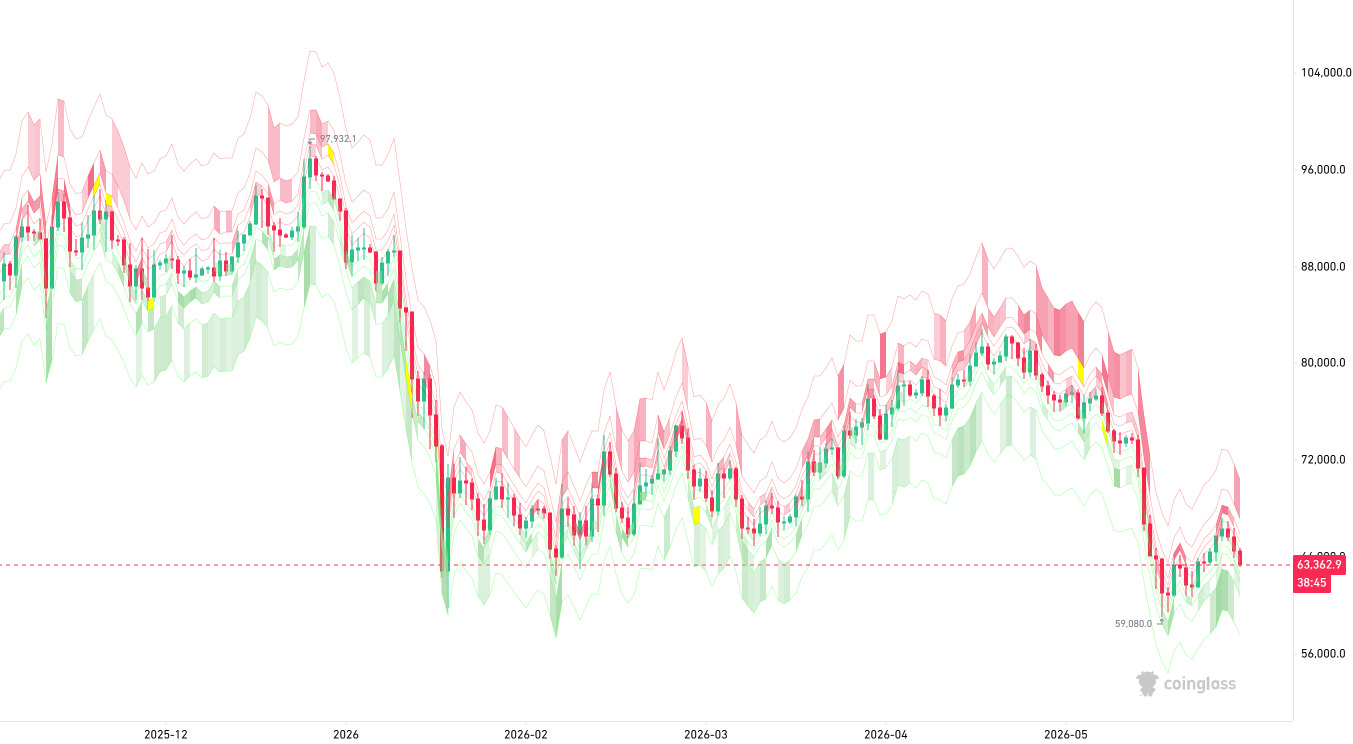
Chart source:CoinGlass
Asset: BTC/USDT
Timeframe: 1 Day Candles
Metrics: Spot order
Data checked: June 18, 2026, 03:00 PM UTC
The green zone, which reflects the cluster of spot buy orders, is noticeably wider and stronger than the red zone of sell orders. The yellow areas mark a sharp change in the composition of the order block - meaning that the green zone currently holds more buyer activity than seller activity at the levels above. In addition, the aggregate order book delta on CoinGlass has been skewed toward buying for the second day in a row.
Chart: BTC Whale Orders & Large Trades
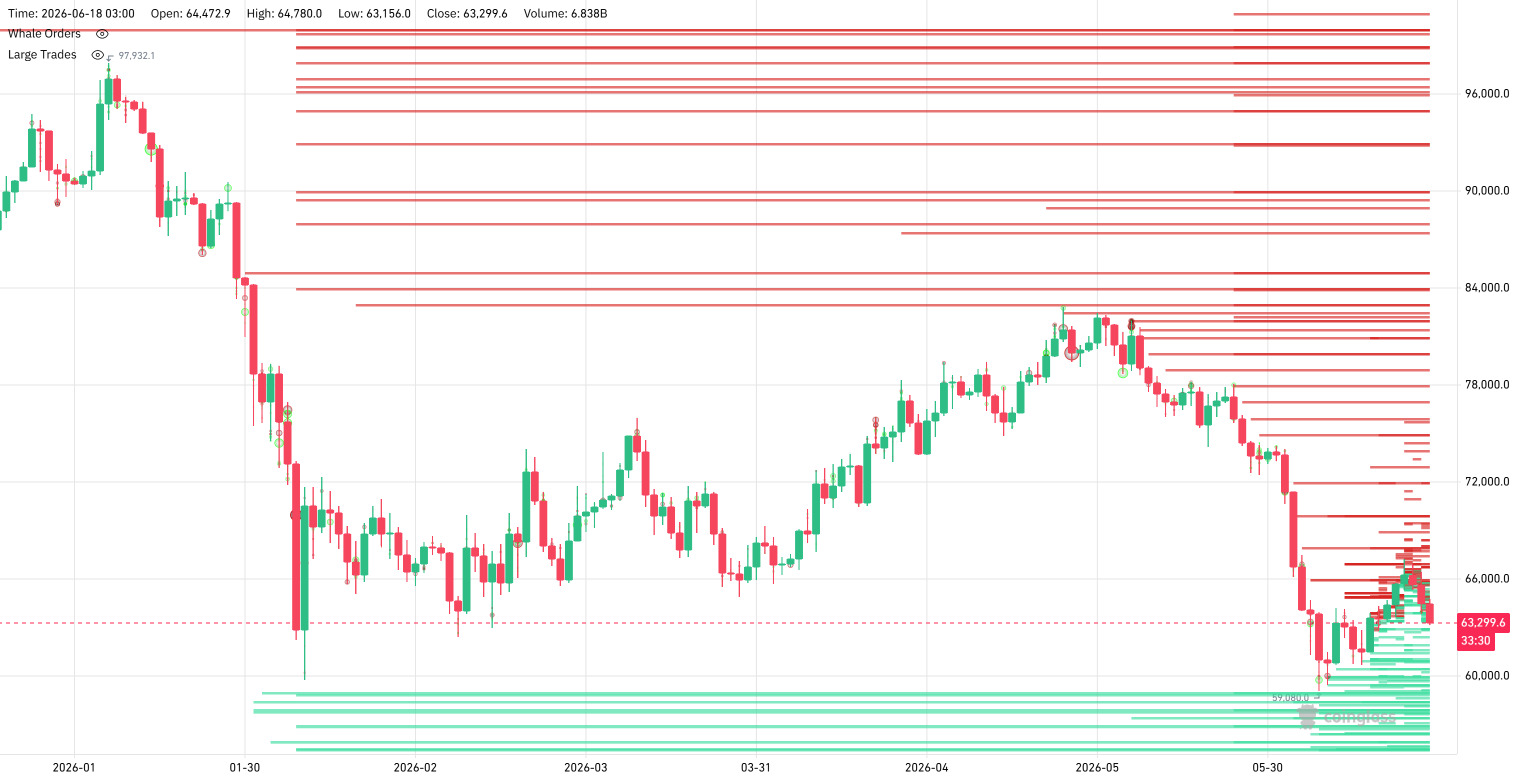
Chart source:CoinGlass
Asset: BTC
Timeframe: 1 Day Candles
Metrics: Whale and large spot orders
Data checked: June 18, 2026, 03:00 PM UTC
A similar structure is visible in the chart of large ("whale") orders on CoinGlass: significant sell orders begin only above the $66,500 mark, whereas large buy orders are placed as low as $63,000. In other words, buy-side liquidity is "stacked" below the market, while serious resistance is concentrated above current levels.
Why It Matters This Week
Despite the post-Fed reversal, there are no aggressive sellers among active market participants in the order book. According to TradingView data, aggregate open interest has declined - which points to a deleveraging of positions rather than spot selling. This is a fundamental distinction: the market is shedding leverage, but there is almost no underlying selling pressure. On-chain data confirms this. According to Glassnode, market participants sitting at a loss did not realize losses en masse while Bitcoin held above $66,000. The absence of capitulation by underwater holders is a positive structural signal, suggesting that holders are not yet losing conviction.
What to Watch Next
The key level for confirming buyer strength is $66,500. A return to and a hold above this zone would ease the pressure from large sellers. A signal that the current structure is weakening would be the order book delta shifting back toward selling and a loss of the $62,000 support.
Analyst Opinion: A Neutral-to-Bullish View While Support Holds
Current view: neutral-to-bullish over the medium term, cautious in the long term due to the post-Fed risk-off.
Rationale: Bitcoin held the $60,000 support last week, underwater holders did not capitulate above $66,000, and the decline in open interest points to deleveraging rather than a sell-off. The order book delta has been skewed toward buying for a second day, with large limit buy orders placed as low as $63,000.
Confirmation level: a return to and a daily close above $66,500 next week would strengthen the medium-term bullish scenario, since that is precisely where large sell orders are concentrated.
Invalidation level: a loss of the $62,000 support would weaken the current structure and shift attention to the risks of a deeper correction or an extended sideways range. The intermediate pullback zone is $61,000-$62,000.
Trading takeaway: over the medium term Bitcoin looks strong as long as price holds key support and order flow retains its buy-side skew. In these conditions, market participants may prefer to wait for confirmation around current levels rather than react to short-term noise, and to closely monitor Iran-related news flow as the main short-term driver.
Scenarios for the Week Ahead
Growth scenario. Bitcoin returns to and closes above the $66,500 zone, where the large sell orders sit, while the order book delta keeps its buy-side skew and progress on the U.S.-Iran track continues to support risk appetite. In this case the move higher could extend and the medium-term bullish structure would be reinforced.
Range scenario. Bitcoin holds between $62,000 support and $66,500 resistance. Deleveraging continues without aggressive selling, and the market waits for clearer macro signals from the Fed and the Iran track. A tactical pullback into the $61,000-$62,000 zone remains possible but stays contained, with buy-side liquidity stacked below absorbing the dips.
Decline scenario. Bitcoin decisively loses the $62,000 support and breaks below the $61,000-$62,000 tactical zone. The order book delta flips back toward selling, the open-interest deleveraging turns into spot selling, and a combination of the hawkish Fed backdrop and a negative Iran surprise opens the way to a deeper correction toward lower levels.
In Focus: The Fed Meeting and the Updated Projections
The main macro event for all risk assets this week, crypto included, was the FOMC meeting on June 17. Below is a breakdown of what actually matters for the market.
The Rate Decision: A Pause Without Surprises
The Committee voted unanimously (12-0) to keep the federal funds target range at 3.50-3.75% and reaffirmed its policy of maintaining ample reserves in the banking system. On the implementation side, the interest rate on reserve balances was kept at 3.65%, the repo rate at 3.75%, the reverse repo rate at 3.50%, and the primary credit rate at 3.75%.
The Tone of the Statement: An Emphasis on Persistent Inflation
The statement itself came out neutral-to-hawkish. The Fed noted that economic activity is expanding at a solid pace despite elevated uncertainty tied in part to the conflict in the Middle East. Productivity growth and capital investment were described as strong, and the labor market as resilient.
The key emphasis was on inflation. The regulator stated plainly that inflation remains elevated relative to the 2% goal, in part because of supply shocks driving up prices in certain sectors, including energy. The line "The Committee will deliver price stability" sets a distinctly firmer tone than the market is used to seeing during an easing phase.
The Main Point: A Hawkish Revision of the Projections
The most important thing for the market is not the decision itself but the updated Summary of Economic Projections, which showed a marked hawkish shift versus March:
PCE inflation for 2026 was revised sharply higher - from 2.7% to 3.6%. Core PCE was raised from 2.7% to 3.3%.
The end-2026 rate projection was lifted from 3.4% to 3.8% - meaning the median participant now assumes effectively no rate cuts this year, rather than the easing cycle implied in March. The 2027 median was raised from 3.1% to 3.6%.
GDP growth was nudged down from 2.4% to 2.2% for 2026, with unemployment around 4.3%.
The distribution of inflation risks among most participants is tilted to the upside, and uncertainty is assessed as "higher than usual."
Taken together, this data confirms what the tone of the statement implied: the Fed views inflation as more persistent and the room for rate cuts as narrower than previously expected.
What This Means for Crypto
For risk assets, this is a "higher for longer" environment: higher rates for longer, support for the dollar and yields, and pressure on crypto over the medium term. That is exactly what we saw - a rise in DXY and U.S. Treasury yields alongside a restrained Bitcoin pullback.
One important nuance: because neither the decision nor the hawkish shift came as a full surprise, a significant share of the negativity was likely already priced in. This explains why the crypto market's reaction was moderate and why the order-flow structure stayed relatively healthy. Even so, as long as the Fed's projections point to persistent inflation, the macro backdrop remains a restraining rather than a supportive factor for risk assets.
Risks for the Week Ahead
- A breakdown or stalling of the U.S.-Iran peace talks and escalation in the Middle East - this could trigger a spike in energy prices and a fresh inflationary impulse.
- More hawkish Fed rhetoric and rising "higher for longer" expectations, with further increases in yields and the Dollar Index.
- Persistent inflation - the 2026 PCE projection has been raised to 3.6%, which limits risk appetite.
- Continued outflows from spot Bitcoin ETFs after the $80 million outflow on Thursday.
- A decisive loss of the $62,000 support, which would shift attention to a deeper correction.
- Rising leverage as open interest recovers - this increases the risk of sharp liquidations.
- A broad risk-off rotation: dollar strength alongside falling risk assets.
The main short-term risk is the combination of a hawkish Fed backdrop and any negative Iran news, which could hit both risk appetite and inflation expectations at the same time.
Watchlist for the Week
BTC support: $62,000, with a tactical pullback zone at $61,000-$62,000
BTC resistance: $66,500 - the zone where large sell orders are concentrated
Order book delta / order pressure: buy-side skew for a second day - watch for it to persist
Open interest: monitor for continued deleveraging
Spot BTC-ETF flows
UST10Y yield and DXY: a rise = intensifying risk-off
Iran news: progress or collapse of the U.S.-Iran peace deal
Final Takeaway
Bitcoin remains in an unconfirmed structure. Holding the $60,000 level last week keeps the neutral-to-bullish scenario alive, while order-flow and on-chain data point to deleveraging rather than a sell-off - which supports the short-to-medium-term view. The main restraining factor remains the hawkish Fed signal and the acknowledgment of persistent inflation, which reinforces risk-off through a stronger dollar and higher yields. Until price either returns above $66,500 or loses $60,000, it makes sense for market participants to focus on confirmation signals and risk management.
Methodology
This weekly update analyzes crypto market structure, technical indicators, liquidity conditions, derivatives data, on-chain activity, and sentiment data through the lens of asset price changes, along with relevant macroeconomic and regulatory developments. The analysis is based on data available at the time of publication and may change as new market information becomes available.
Disclaimer
This article is for educational and informational purposes only and does not constitute financial, investment, or trading advice. Crypto assets are volatile, and past performance is not a reliable indicator of future results. Always conduct your own research and consider your risk tolerance before making trading decisions.



.jpg)